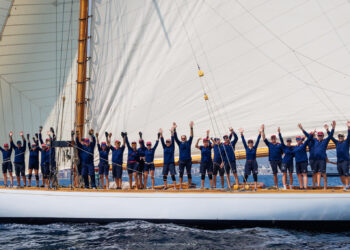
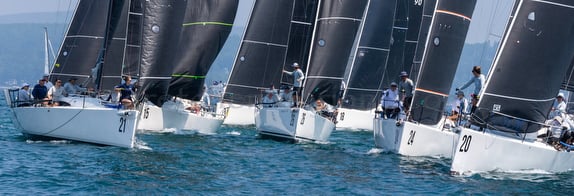
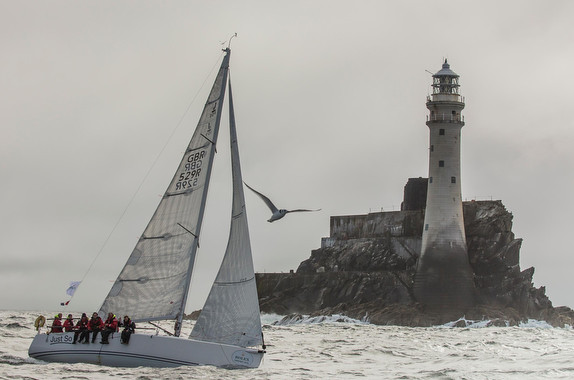
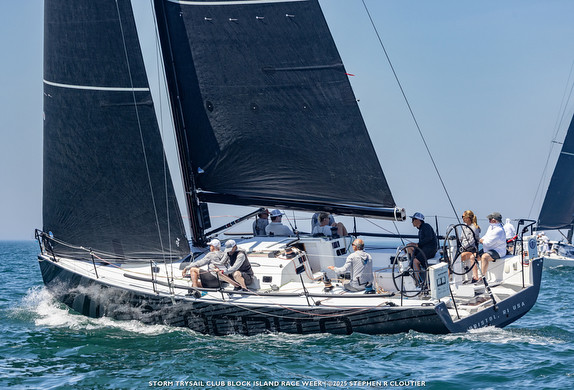
(Cowes, Isle of Wight, England)- Marking the 100th anniversary of the Royal Ocean Racing Club, the 2025 edition of the ROLEX Fastnet Race is certain to be a special one. From its humble beginnings, the race upon which the Royal Ocean Racing Club (RORC) was founded has grown to become the world’s biggest offshore race, with 381 IRC-rated yachts competing. From the start off the famous Cowes/ Royal Yacht Squadron starting line in the Solent, the fleet rounds Fastnet Rock just off the southeastern tip of Ireland, then heads for home to the finish off Cherbourg-en-Cotentin, France- a distance of 695.0nm.
Making HistoryIn 1925, before offshore racing was even a sport in the United Kingdom, seven cruising yachts and their valiant crews embarked on what was then called “the Ocean Race”. Inspired by the Newport Bermuda Race, the U.K. equivalent was started off Ryde Middle in the Solent by the Royal Victoria Yacht Club. The fleet headed counter-clockwise around the Isle of Wight, before heading west to Land’s End, crossing the Celtic Sea to the Fastnet Rock lighthouse, rounding it to port and returning to the finish off Plymouth, England.
Weather ForecastTeams that competed in the last two ROLEX Fastnet Races and are returning for this Saturday’s special centenary edition will be breathing a sigh of relief looking at the long-term forecast. In contrast to the battering they received from the 30+ knot winds at the start, and the subsequent gale force winds of the first 24 hours, they endured during the last two editions, the long-term forecast for this year’s race shows more benign conditions.
Regardless of the wind conditions, the Rolex Fastnet Race is never easy as it always involves making best use of or attempting to avoid the tide, especially while exiting past the Solent past The Needles and off southern England’s famous headlands – St Alban’s Point, Start Point, the Lizard, Land’s End – and again at the end of the race when all competitors will be affected, for better or worse, by the powerful Alderney Race (a massive cut of fast-moving current) on the approach to Cherbourg.
Along the way, competitors must avoid the Traffic Separation Schemes (TSSs). Exiting the Solent, the Casquets TSS mid-channel limits how far south boats can go before they are obliged to tack. Tactically, one of the most important TSS zones lies off Land’s End, where the shorter passage is between this and the Scilly Isles. But, depending upon the state of wind and tide, it can also be advantageous to take the longer route between the TSS and Land’s End.
Another TSS is immediately south of the Fastnet Rock, acting as a natural spreader mark, separating yachts arriving at the Rock from those exiting it. TSSs also lie to the west and south of the Scilly Isles, and there is a further tactical option to leave the former to port or starboard. Finally, the Casquets TSS once again comes into play, forcing competitors south of it and causing some even to pass south of Guernsey to avoid the worst of the tide en route to the finish line.
While at present the weather looks like it will be dominated by a giant area of High pressure off to the west and southwest, the shape of this and a micro system that may or may not be spinning up in the Celtic Sea on start day are currently playing havoc with the routing.
It’s tricky,” comments Will Best, navigator on Leopard 3. “The difference between yesterday and today is almost 24 hours in routing for us. There’s a system coming, and at the moment, the timing, intensity, and associated weather are not lining up. The U.K. model is quite a big outlier at the moment. The Euro model is looking better today compared to what we expect – probably two and a half days for us. Yesterday, it was a pure windward-leeward with quite light VMG downwind to the finish. Today, it’s not crazy wind speeds, but it just turns into a reach to the finish, which saves us hours on these 100s. It’s pretty normal for it to be this inconsistent so far out.”
RORC Rear Commodore Joe Lacey is racing double-handed. “Big picture, the weather is basically stable,” he says. “There’s high pressure over the Atlantic, which the entire fleet is probably going to be in for the entirety of the race. The exact position of that high pressure changes the angles. For example, going along the south coast, it could be upwind, or it could be reaching. And going across the Irish Sea, it could be upwind, and it could be reaching.
At the moment, it says we’re going to be upwind in 12-15 knots at the start, but then it will take us 24+ hours to go along the south coast of the UK, so by Sunday, we should be reaching. Maybe we will still get some shifts, but I don’t think it’s very stable. The forecast is changing daily. At the moment, it’s giving us some positive readings: our fleet will finish in 3.5-4 days, and it goes well for us if we can reach along the coast of England. At the moment, we’ll never have more than 20 knots of wind and never less than eight knots.
It’s going to be a pretty standard beat out of Solent, because it’s a prevailing northwesterly. Once we get out into Christchurch Bay, it could swing round a bit. I don’t know whether it’ll go fully into a reach until we get towards Weymouth.
To the Fastnet Rock, it looks like the wind oscillates between 10 and 20 knots – possibly slightly more as we get closer. And then it’s putting the kite up and going all the way to Cherbourg by the looks of it.”
Royal Engineer Yacht Club’s J/109 ProjectAs regular as the Fastnet Race has been the RORC’s premier event, so has been the Royal Engineer Yacht Club (REYC), which – incredibly – has participated in every single edition. Since 1925, they had already been competing in offshore races for decades.
Since 2021, they have been campaigning their J/109 TROJAN in what is arguably one of the most competitive one-design classes in southern England.
“There’s definitely an undertone of pride to it,” says Andrew Motion, the REYC’s Captain of Boats, TROJAN crew in 2021 and skipper in 2023. “There’s also quite a lot of pressure that comes with it. There’s a real expectation that it’s a no-fail event for us.”
Along with many other services, yachts, their J/109 TROJAN, are based out of Hornet Services Sailing Club in Gosport. In the Rolex Fastnet Race, they compete for the Inter-Regimental Cup for Best Service Yacht Overall and the Culdrose Trophy for Best IRC Services Yacht around the Fastnet Rock on corrected time.
Of their 2025 campaign, Motion adds: “We’ve got servicemen and women coming from all over the country. But, there’s a lot of pressure because of the centenary and because we’ve entered every single one and should continue to do so. It makes it all the more important to achieve. Whatever happens, come hell or high water, we will have that boat across that start line!”
IRC 1 DivisionThe massive 73-boat fleet has four well-prepared offshore J/crews. One of them is the J/121 DARKWOOD from Ireland. Over the years, DARKWOOD has not enjoyed the luck of the Irish, with a retirement in 2019 following rudder damage, and then a collision shortly after the start in 2021. But her owner/skipper Mike O’Donnell is nothing if not persistent, and 2025 is shaping up to be a good year for the J/121 from Ireland. Currently, DARKWOOD lies third overall in IRC One in the RORC’s Season’s Points Championship.
The other J/Teams include Herve Perrein’s J/130 DULCISSIMA, Francois Charles’s J/133 SUN HILL IV from France, and Nick Edmonds’s J/45 STICKLEBACK.
After winning IRC Four in their beloved SUN HILL III in 2023 (and coming third in class twice before), François Charles and his French crew return on SUN HILL IV, a substantially larger, faster J/133. She arrived on Tuesday from Charles’ native Morlaix, where he is a rigger. Morlaix has produced several top French sailors, including Solitaire du Figaro winners Jérémie Beyou, Armel le Cleach, and Nicolas Troussel, who has been calling tactics on board this season. Despite only acquiring their boat this year, they have already notched up a second place in the Cervantes Trophy in IRC One.
As to their prospects this year, Charles says he is resigned to the tough challenge ahead, racing the wily Géry Trentesaux and his now fully tricked-up LONG COURIER. “We want to use this to discover the boat – it’s much faster than our last one, which I’m very happy about,” says Charles. His team has a sponsor/ supporter in his Rolex Fastnet Race campaign by the Cabinet Bourhis Insurance company. “That’s good because it allows us to buy more sails!!” Charles is racing with five crew ranging in age from 22 years to 65.
IRC 2 DivisionThis very large 70-boat fleet has a significant armada of J/crews- nine boats total.
One of the contenders is Lawrence Herbert’s J/133 CORAZON. They scored a second place in IRC Two in the Myth of Malham, and their young crew (all under 30) have been performing well across the past three seasons of RORC racing.
Derek Shakespeare, Vice Commodore of RORC, has been successfully campaigning his J/122 BULLDOOG, with an overall win in RORC’s De Guingand Bowl Race last year as some indicator of the boat’s potential.
JENIS is a J/112 GP from Kazakhstan, skippered by Murat Abdrakhmanov. Last year, this Kazakh crew finished second in class in the Rolex Giraglia Cup.
The J/122 MOJITO, owned by Peter Dunlop and Victoria Cox, and racing out of Pwllheli Sailing Club, participated in the RORC Nelson’s Cup Series and the RORC Caribbean 600 in Antigua in early 2025. In the Nelson’s Cup, MOJITO won races during the week and, ultimately, finished runner-up in IRC Two. In the Caribbean 600, MOJITO also finished second in class.
Cris Miles has covered plenty of sea miles in his professional career, having completed many, many ISORA races, Scottish Islands Peaks Race, and the Three Peaks Yacht Race. However, this is his first attempt at the Rolex Fastnet Race, and he’s skippering the J/111 JEZEBEL. Miles describes his crew as “an exemplary bunch of guys with military background,” but adds intriguingly: “Professions are on a need-to-know basis.” One of the crew will also be scattering the ashes of his late father at the Fastnet Rock as per his wishes.
The J/122 WHISKEY JACK is a well-known name in the world of offshore racing in the Far East. Owner/skipper Nick Southward of the J/122 is looking forward to showing what his Hong Kong crew can do in the Rolex Fastnet Race. A fifth place in IRC Two at the Myth of Malham suggests WHISKEY will be one to watch for the Rolex Fastnet Race.
Frans van Cappelle’s experienced crew from the Netherlands has had good offshore success on the North Sea, racing their J/122 MOANA. Their most recent performance was a podium finish in the well-known North Sea Week.
Finally, just beginning to scratch the surface of the potential of their new race horse, the French team on the J/45 JUST, led by the experienced offshore trio of Sacha Vandenbrouck, Yvon Lucas, and Eric Gautier, hope to lead their fellow J/teams across the finish line in Cherbourg!
IRC 3 DivisionIn a still larger fleet of 86 boats, there will be a fleet of seven J/Teams. Here’s the principal guiding force for all IRC 3 participants: it’s always an intensely competitive class! And, it has produced the overall winner of two of the last six Fastnet Races!!
Picking out potential class winners at this stage is an almost impossible task. Competition so far this year in IRC Three has been exceptionally close, with 12 boats from four different countries scoring top-four places in the first five races of this year’s RORC series.
Three J/112E’s are competing and, given the current weather forecasts, they should prove to be quite competitive. Those teams include Simon Harris & Charles Linard’s J’OUVERT, Ubbo Neisingh’s Dutch team on NARWAL, and Wayne Palmer & Kate Ledgard’s THINKING SPACE.
A trio of J/99s should also be significant factors in the division. There are two French teams (Jean-Lin Flipo’s YALLA and Julien Bentz’s WHIMJY 99) and one British crew- Alain Waha’s FURTHER WEST.
Rounding out the J/fleet is Frenchman Philippe Girardin’s very experienced, winning offshore crew on his J/120 HEY JUDE. They’re accustomed to winning silverware in their French offshore circuit!
IRC 4 DivisionIRC Four division, representing the smallest and lowest-rated boats in the race, is the most numerous this year, with 95 entries. They vary from enormously experienced and competitive teams with the potential to lift the Fastnet Challenge Cup, the main IRC Overall prize, to those chasing a bucket list experience. Nevertheless, many of the latter will inevitably get hooked on the race and join the legions of sailors who compete time after time and notch up a dozen or more editions.
An impressive ten J/109s are entered this year. Among them is JUST SO, which has been hugely successful in offshore racing in the 18 years the McGough family has owned her, gaining a slew of trophies. However, success in the Rolex Fastnet Race has always proved elusive, and JUST SO had to retire in both the 2019 and 2021 editions. The ambition this year is modest but heartfelt: “Our main goal is to finish!” says skipper William McGough.
Lesley Brooman is the third owner of her J/109 JUMUNU and has previously taken part in six Rolex Fastnet Races, two in her boat, plus two RORC Caribbean 600s, one Rolex Middle Sea Race, as well as the Sevenstar Round Britain and Ireland Race. She says their hope is “to finish, preferably in the top half” and for “better weather!”
Other leading J/109s include Rob Cotterill’s MOJO RISIN, which has notably won silver in both Warsash Spring Series and Hamble Winter Series for what seems like decades.
A trio of J/99s will be joining them to vie for division honors. They include Mark Kendall’s JIRO, Jean-Baptiste Brian’s JOLLY JUMPER, and Tim Tolcher & Steven Deutsch’s RAGING BULL.
FEVER, a Dutch-flagged J/35 of 1984 vintage, will be sailed by a group of friends from the Jachtclub Scheveningen, including Volvo Ocean Race and America’s Cup veteran Simeon Tienpont. The plan is to “sail a neat race from start to finish and have a good time,” says Tienpont. “The most challenging thing will be the luck of timing and good tactical decisions at the finish, considering the strong currents in France.”
IRC Doublehanded DivisionThe fifty-seven boats in this fleet seem to have a common theme- the father and daughter team aspect particularly appeals to several families, providing them a race within the race. One of them is Richard and Emma Breese, who are competing in an older, but competitive boat, the J/105 MOJO. Emma has a long track record of making boats go fast, having been Optimist Junior National Champion in 2019, and finishing as second female at last year’s 420 Youth National Championship– dinghy sailors are fast in J/105s!
MOJO will be up against a “rogue’s gallery” of tough offshore competitors, all with proven silver-winning performances offshore. There are two J/112E’s- the Harris & Linard duo on J’OUVERT and the Palmer & Ledgard pair on THINKING SPACE. In addition, the J/99 RAGING BULL will have the Tolcher & Deutsch team, who are persistent and smart. Finally, a past RORC Season Series IRC Double winner is the McGough & Lavery pair on the J/109 JUST SO.
For more ROLEX Fastnet Race sailing informationhttps://www.rolexfastnetrace.com/en